Comparison
MOSS-TTS vs Chatterbox vs ZONOS2: The New Open Voice-Cloning Race
A source-backed comparison of MOSS-TTS v1.5, Chatterbox Multilingual V3, and ZONOS2 for voice cloning, languages, hardware, streaming, licensing, and creator work.
 Murmur9 min read
Free plan with Kokoro voices, scripts up to 1,500 characters · 3-day Pro trial, then $49 once
Verdict: choose Chatterbox Multilingual V3 for the easiest compact multilingual clone, MOSS-TTS-v1.5 for long-form control, explicit pauses, pronunciation tools, and a broader local deployment story, and ZONOS2 when an NVIDIA Linux server can support an 8B mixture-of-experts model built around naturalness and high-fidelity cloning. There is no measured overall winner yet. The three official projects publish different evaluations and demos, so their headline claims are not directly comparable. For Mac creators, Chatterbox has the clearest MPS path today. MOSS has MLX-Audio support and a 4B local v1.5 checkpoint. ZONOS2's official local instructions currently require Linux, x86-64, NVIDIA, and CUDA.
Quick Comparison
| Factor | MOSS-TTS-v1.5 | Chatterbox Multilingual V3 | ZONOS2 |
|---|---|---|---|
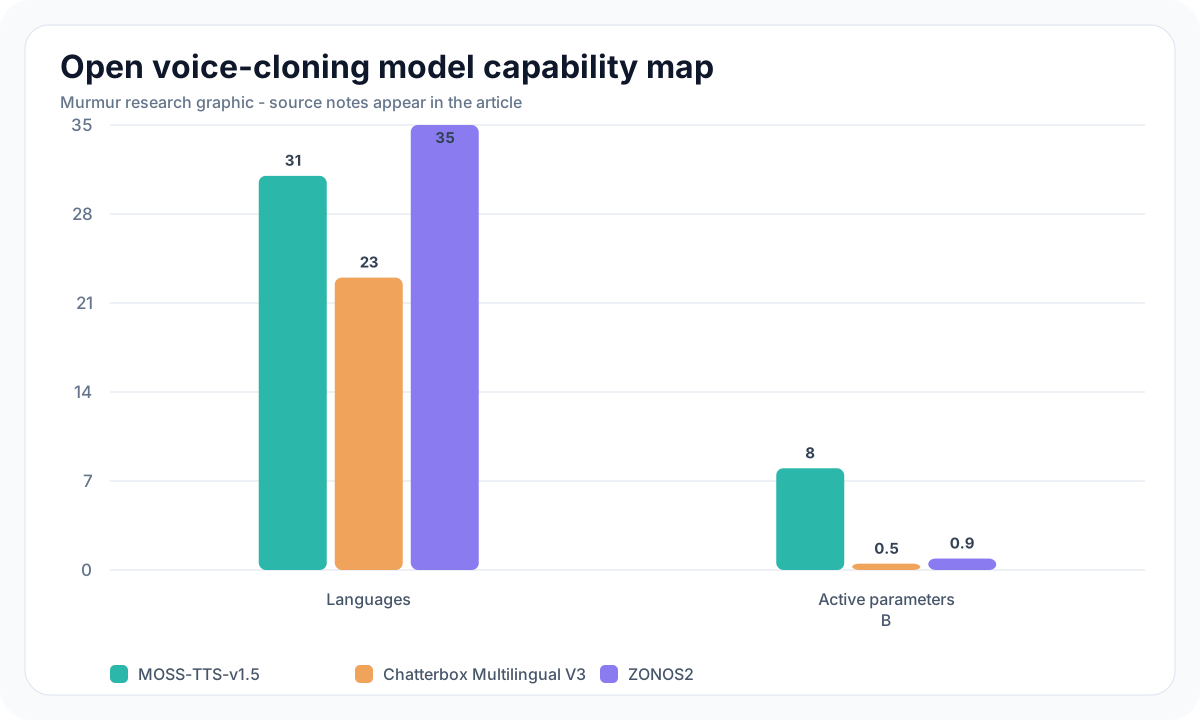
| Official size | 8B flagship; 4B Local Transformer v1.5 | 500M | 8B total, 900M active |
| Languages | 31 | 23+ in repository | 35 listed across three quality tiers |
| Voice cloning | Zero-shot reference audio | Zero-shot reference audio | Zero-shot prompt audio without transcript |
| Output | 24 kHz flagship tokenizer path; 48 kHz stereo Local v1.5 | Model-specific output; check current card | 44.1 kHz mono in official server example |
| Control | Pause tags, duration, Pinyin, IPA, code-switching | CFG, exaggeration, language ID; Turbo has reaction tags | Speaking rate and optional Quality Mode |
| Streaming | Supported across documented backends | Turbo targets low latency; V3 is general multilingual | Streaming server path |
| Official Mac story | MLX-Audio support; exact checkpoint compatibility must be verified | Code example lists MPS | No official local Mac path; Linux NVIDIA only |
| License | Apache 2.0 family | MIT repository and model family | Apache 2.0 model and code |
| Best fit | Controlled long-form and deployment flexibility | Compact multilingual creator workflow | High-end server cloning and naturalness tests |
In This Comparison
- What changed in the latest releases
- Voice-cloning differences
- Language coverage
- Long-form and punctuation control
- Hardware and Mac compatibility
- Licenses and watermarking
- Official audio demos
- A fair three-model test
- Which model fits each buyer
- Frequently asked questions
These Are Three Different Product Bets
MOSS-TTS is a family rather than one checkpoint. The 8B MOSS-TTS-v1.5 flagship uses the delay architecture, while the newer 4B MOSS-TTS-Local-Transformer-v1.5 uses a local transformer and MOSS Audio Tokenizer v2 for native 48 kHz stereo. OpenMOSS also ships dialogue, voice-design, real-time, nano, and sound-effect models. The comparison here uses the flagship v1.5 capability set and calls out the 4B local checkpoint where hardware differs.
Chatterbox Multilingual V3 is Resemble AI's 500M general multilingual model. The official repository says V3 improves speaker similarity, reduces unwanted continuation and repetition, and produces more natural multilingual speech than earlier versions. It supports 23+ languages in the project table and offers separate 500M single-language packs for six priority variants. Chatterbox Turbo is a different 350M English model; do not attribute Turbo's reaction tags or low-latency positioning to Multilingual V3.
ZONOS2 is Zyphra's 8B total-parameter model with 900M active parameters per token. Its technical report describes a mixture-of-experts backbone trained on more than 6 million hours, up from 200,000 hours for Zonos v0.1. It uses raw-byte text tokenization, an ECAPA-TDNN speaker embedding, and Descript Audio Codec tokens. The official card groups 35 languages into three quality tiers rather than presenting them as equal.
Voice Cloning: Prompt Requirements and Control
All three can clone a voice without speaker-specific fine-tuning, but the surrounding workflow differs. MOSS-TTS builds a user message with target text and reference audio. V1.5 specifically targets more stable cloning and better behavior when the reference is much longer than the target. The model family also supports long speech, token-level duration control, Pinyin and IPA pronunciation control, multilingual synthesis, and code-switching. Those controls make MOSS attractive when matching a voice is only one part of the production problem.
Chatterbox passes an audio_prompt_path to the generator. Its general model exposes exaggeration and classifier-free guidance weight. Resemble advises matching reference and target language and notes that lowering CFG can help a fast reference speaker. V3's main appeal is a compact package for cross-language identity. It also embeds Resemble's Perth watermark in generated audio. The repository says the watermark is designed to survive MP3 compression and common edits.
ZONOS2 derives an ECAPA-TDNN speaker embedding from prompt audio and does not require a transcript of that recording. The report describes unbounded prompt-utterance length and exposes speaking-rate selection plus optional Quality Mode. The model's active-parameter design aims to gain capacity without paying the full 8B compute cost at every token. Even so, the official quick start is a server-class setup, not a lightweight laptop package.
Language Counts Need Context
MOSS-TTS-v1.5 and the 4B Local Transformer v1.5 document 31 languages. The release retains 20 from version 1.0 and adds continued multilingual training for Cantonese, Dutch, Finnish, Hindi, Macedonian, Malay, Romanian, Swahili, Tagalog, Thai, and Vietnamese. OpenMOSS recommends providing language tags when known. It also documents code-switching, a separate requirement from supporting two languages in isolated sentences.
Chatterbox lists Arabic, Danish, German, Greek, English, Spanish, Finnish, French, Hebrew, Hindi, Italian, Japanese, Korean, Malay, Dutch, Norwegian, Polish, Portuguese, Russian, Swedish, Swahili, Turkish, and Chinese. Its single-language packs currently target Chinese, Latin American Spanish, Brazilian Portuguese, Spain Spanish, Portugal Portuguese, and Hindi. Those packs matter when a regional production needs tighter behavior than the general model.
ZONOS2's card is the most candid about uneven language quality. Tier 1 contains English, Mandarin Chinese, and Japanese. Tier 2 contains Korean, Russian, Italian, Portuguese, French, Spanish, Vietnamese, German, Hebrew, and Dutch. Tier 3 adds 21 more. Buyers should treat a tier as a test priority, not a guarantee. A native speaker still needs to review names, loanwords, numbers, and accent transfer.
Long-Form Speech, Pauses, and Punctuation
MOSS has the clearest published long-form tool set. V1.5 says it improves punctuation-following prosody and accepts an explicit [pause X.Ys] tag. The flagship also exposes token-level duration and pronunciation control. Those features help an audiobook producer fix one sentence without changing the words or splicing hand-made silence into every section.
Chatterbox V3 focuses its current release message on similarity, hallucination reduction, and multilingual naturalness. It does not advertise the same pause-tag, Pinyin, IPA, or token-duration system. Its controls can shape exaggeration and guidance, but a full chapter still needs chunking and a completion check. Do not assume “reduced hallucinations” means zero repeated or appended text.
ZONOS2 reports streaming latency and long prompt support, but the technical report's strongest claims concern naturalness, similarity, word error rate, and the new ZTTS1-Eval benchmark. A production comparison should test 10,000 words, not infer endurance from a short official sample. Measure missing paragraphs, repeated clauses, pacing drift, crashes, and beginning-to-end speaker similarity.
Hardware and Local Deployment
| Deployment question | MOSS-TTS | Chatterbox V3 | ZONOS2 |
|---|---|---|---|
| Can official docs start on Mac? | Family lists MLX-Audio support; verify desired v1.5 checkpoint | Yes, example device includes mps | No, official ZONOS2 card says Linux x86-64 and NVIDIA CUDA |
| Low-memory option | Q4 GGUF path; OpenMOSS says 8B fits an 8 GB GPU with optimized llama.cpp | 500M model, plus MPS or CPU device options | MoE activates 900M of 8B, but official runtime remains GPU server |
| Server backend | SGLang-Omni and vLLM-Omni | Python package or hosted Resemble service | Mini-SGLang local server on port 1919 |
| Audio tokenizer | MOSS Audio Tokenizer; Local v1.5 uses v2 48 kHz stereo | Internal Chatterbox pipeline | DAC tokens, 44.1 kHz server output example |
| Operational complexity | Highest choice of checkpoints and backends | Lowest model size and simplest local example | Highest platform constraint |
MOSS offers the broadest deployment menu but also the most naming risk. An 8B delay checkpoint, 4B local transformer, 100M Nano model, GGUF conversion, and MLX runtime are not interchangeable. Record the exact repository and commit. The current OpenMOSS README says PyTorch-free inference can combine llama.cpp and ONNX Runtime, while an optimized route fits the 8B model on an 8 GB GPU.
Chatterbox's 500M size makes it the most approachable of the three. Its example explicitly accepts cuda, cpu, or mps. That is a clearer Mac path than ZONOS2, though real-time factor and peak unified memory still need measurement on each chip. Read the local voice-cloning app comparison before deciding whether to manage the environment directly.
ZONOS2's official local card is unambiguous: Linux only, x86-64, NVIDIA GPU, and matching CUDA toolkit. An MLX community conversion may exist, but it is not the official supported route and must be verified separately. A Mac owner should not download an 8B checkpoint based on the word “local” and expect the upstream command to run.
Licenses, Consent, and Watermarking
The MOSS-TTS family states Apache License 2.0. ZONOS2's report and model card also use Apache 2.0. Chatterbox's repository uses MIT. These permissive licenses cover their defined software and model artifacts. They do not grant rights to a speaker's identity, a copyrighted script, a celebrity recording, or an official demo file. Commercial teams still need consent, provenance, and an acceptable-use review.
Chatterbox includes a technical provenance feature the others do not foreground: every generated file carries a Perth perceptual watermark. Resemble supplies detection code and says it survives common transformations. A watermark does not replace consent, but it gives downstream teams a way to test whether audio came through the model's watermarking path. Preserve an unedited output for audit before mastering.
Listen to Official Examples Before the Fair Test
Use the OpenMOSS demo section, Chatterbox listening page, and Zyphra's ZONOS2 samples to understand each team's intended strengths. Keep these as links. The code and model licenses do not automatically grant Murmur permission to download and rehost every demo recording or promotional video.
Official examples are not a head-to-head test. They use different scripts, languages, reference speakers, seeds, hardware, and selection methods. The fair comparison must generate one consented reference voice and one fixed script on every model. Publish the reference, all settings, unedited WAV outputs, completion transcript, and failed attempts.
The Benchmark Chart We Need
A useful chart plots script completion against blind naturalness, then encodes peak memory as bubble size. A second panel should show time to first audio and total generation speed. Do not insert model-team benchmark numbers into one ranking because the datasets and evaluators differ. Murmur's fixed-script values should remain null until generated and verified.
Which Open Voice-Cloning Model Should You Choose?
- Choose MOSS-TTS-v1.5 when long-form control, pause tags, pronunciation tools, code-switching, and multiple deployment backends justify a larger system.
- Choose MOSS-TTS-Local-Transformer-v1.5 when 48 kHz stereo and the 4B local architecture match your runtime.
- Choose Chatterbox Multilingual V3 when a compact 500M model, MPS support, 23+ languages, simple cloning, and embedded watermarking fit the job.
- Choose a Chatterbox single-language pack when one supported regional variant matters more than broad multilingual coverage.
- Choose ZONOS2 when you have an NVIDIA Linux server and want to evaluate its 8B MoE capacity, tiered language set, naturalness, and voice-cloning fidelity.
- Choose none until a consented test voice, target-language reviewer, and exact commercial rights path are available.
Mac creators can browse Murmur's available voice workflows, compare the wider field in the local TTS model guide, and learn the Apple Silicon runtime basics in What Is MLX TTS?. The model with the strongest paper is not always the model that fits a repeatable editing and export workflow.
Frequently Asked Questions
Conclusion
The MOSS-TTS vs Chatterbox vs ZONOS2 decision turns on deployment as much as voice quality. Chatterbox V3 is the compact Mac-friendly starting point. MOSS-TTS-v1.5 offers the deepest long-form and pronunciation controls, with a growing set of runtimes and checkpoints. ZONOS2 makes the strongest server-scale bet with 8B total and 900M active parameters, but its official local path excludes Mac. Listen to official examples, then ignore brand labels and run one fixed, consented test before choosing.
Try Local Voice Workflows on Apple Silicon
Download Murmur to manage supported local voices, projects, generation history, and exports in one native Mac app. Buy Murmur for $49 as a one-time purchase.
macOS 15+ · Apple Silicon required · 7-day refund policy